Obtains the probability of co-occurrnece for species from a fitted generalized linear latent variable model object.
# S3 method for class 'gllvm'
predictPairwise(
  object,
  spp = NULL,
  se.fit = FALSE,
  alpha = 0.95,
  seed = 42,
  ...
)
Arguments
- object
an object of class 'gllvm'.
- spp
a vector of length 2, defaults to NULL. If NULL, returns the probability of co-occurrence for all species in the data.
- se.fit
logical, defaults to
FALSE. If set toTRUE, returns a simulated confidence interval of the prediction.- alpha
numeric between 0 and 1, defaults to 0.95. Confidence level of the prediction.
- seed
numeric, defaults to 42. Seed for the simulation of the confidence interval.
- ...
arguments passed to
"predict.gllvm".
Value
A matrix of size np(p-1)/2 by 2.
Details
The probability of co-occurrence is simply given by the joint probability of getting two presences for any pair of species. As such,
it is simply calculated as the product of the probability of occurrence for any pair of species, so that this function mostly serves
as convenience wrapper around "predict.gllvm".
See also
Examples
# \donttest{
# Load a dataset from the mvabund package
data(spider, package = "mvabund")
y <- as.matrix(spider$abund)
X <- scale(spider$x)
# Fit gllvm model
fit <- gllvm(y = y, X, formula = ~soil.dry, family = poisson())
# fitted values
newX = data.frame(soil.dry = seq(min(X[,"soil.dry"]),
max(X[,"soil.dry"]), length.out=100))
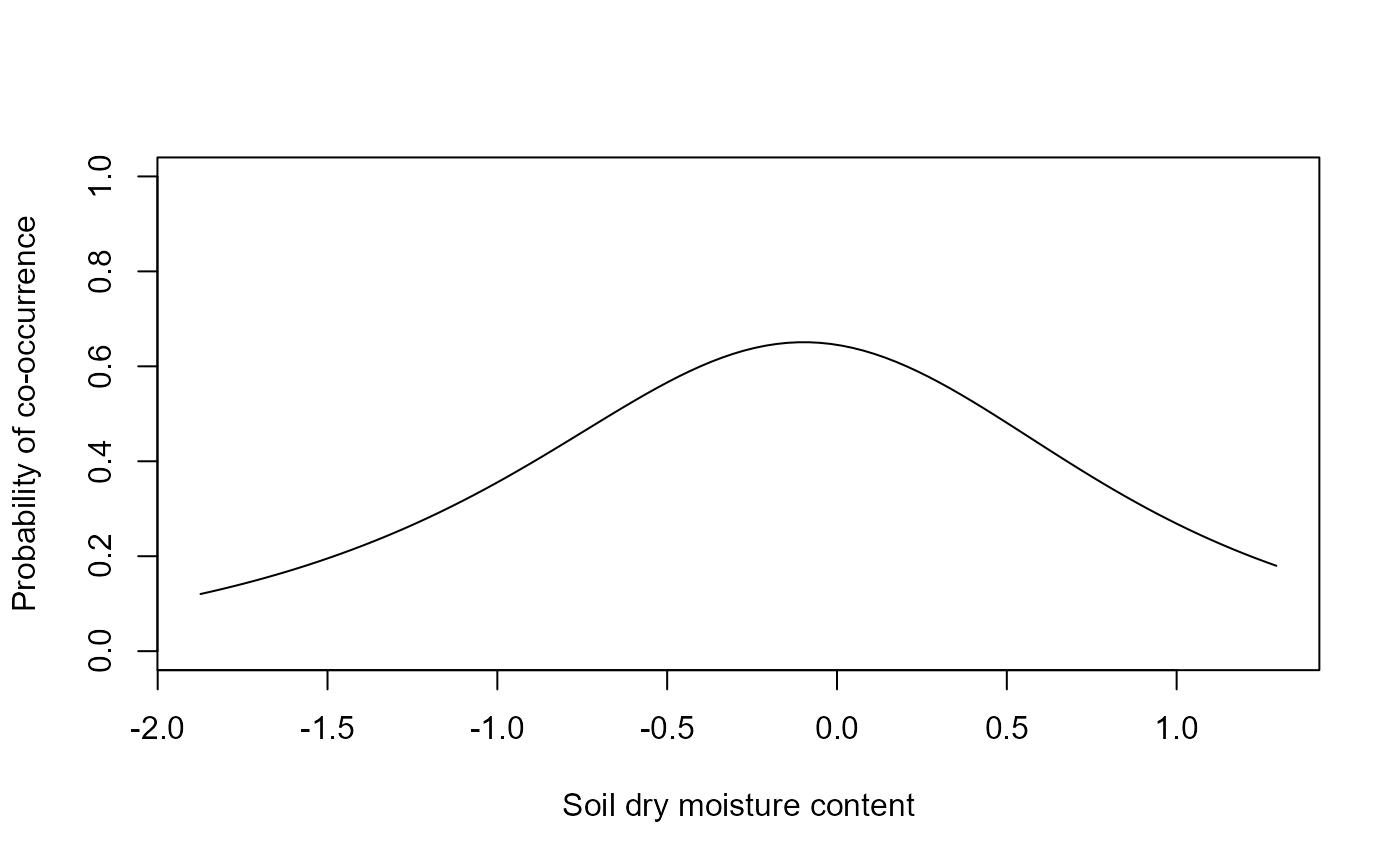
predPair <- predictPairwise(fit, spp = c(1,2), newX = newX, level = 0)
plot(x = newX$soil.dry, y = predPair$prob, type = "l",
xlab = "Soil dry moisture content",
ylab = "Probability of co-occurrence", ylim = c(0,1))
 # }
# }